Playbook
How to play against this pool, computed
A complete strategy for single-raised pots against the model of one pool: not advice written by a coach, but the best response computed across the whole game, with a confidence level on every rule.
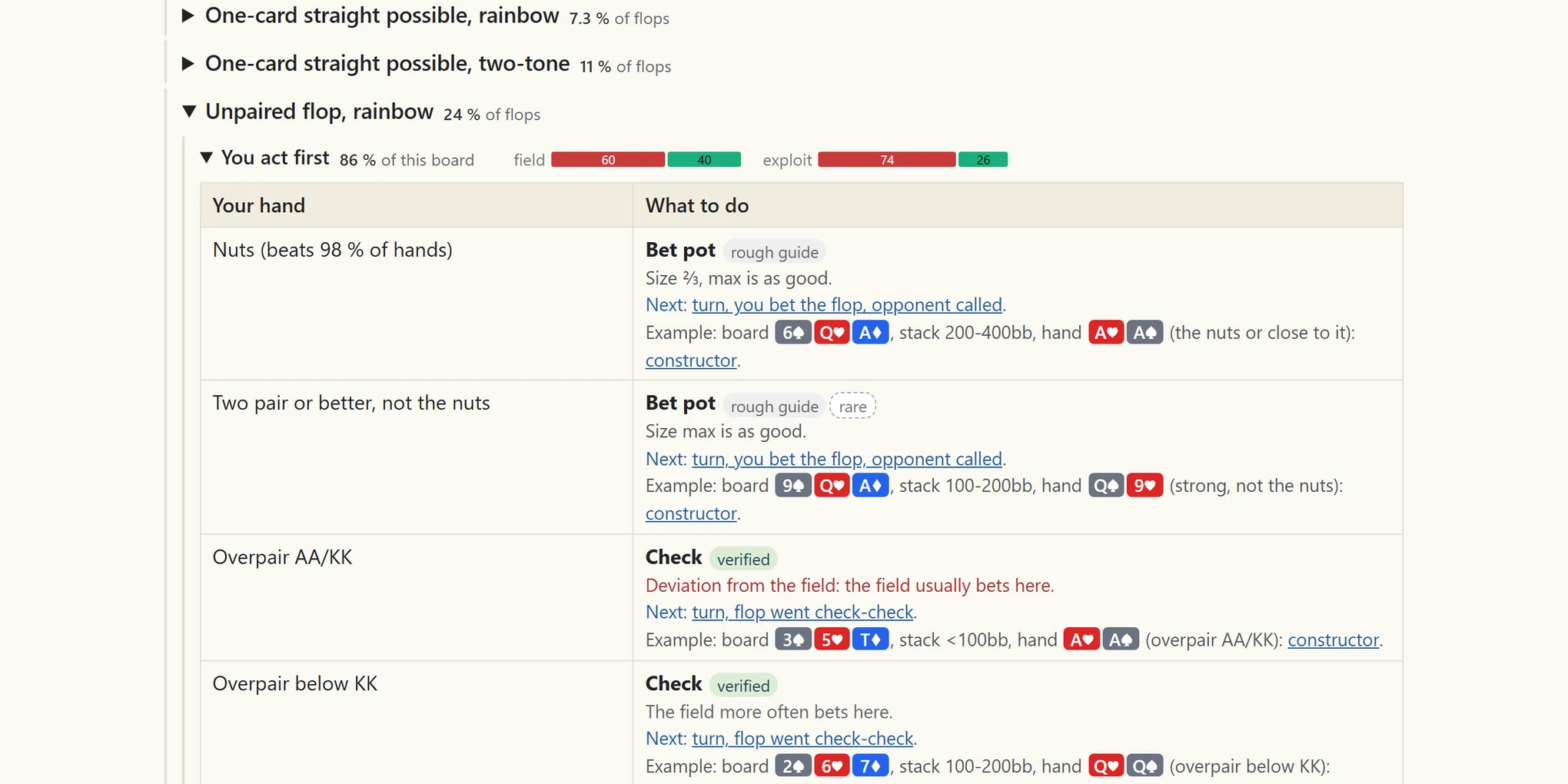
Single-raised pots, heads-up to the flop, against the NLHE Zoom 8-max with straddle pool. The document opens after sign in, like the explorer.
An experimental result. This is the first full pass of a method, not a finished product. There is a lot of work left, and some of it is listed below. It is shown as it is, marked experimental. At the same time, as far as I know, nobody has had this tool before: a readable, complete strategy against a specific real pool, computed from a model of that pool and checked against boards the computation never saw.
What is in the document
How it was built
The starting point is the same model of the pool that runs in the Model Explorer: for any spot and any hand it says how this pool plays. The explorer computes the best response against that model in one spot at a time. The playbook does it across the game.
- Thousands of real spots. Single-raised pots that reached the flop heads-up are sampled from play, so the document covers the situations that actually come up, in the proportions they come up. For every spot the best response is computed against the model and played out to showdown, which gives the value of every action with every hand.
- Spots are described by what you can see. Role, position, who acted and how, the texture of the flop, the card that came on the turn or river, and the class of your hand. The rule for a cell is the action that loses the least across all the spots in it. Where one cell needs a different action on a different texture or card, the cell is split.
- The streets agree with each other. A best response in one spot assumes perfect play afterwards. A rule in a document cannot. So the turn rules are computed assuming you then play the river by the published river rules, and the flop rules assuming the published turn and river. The document is consistent with itself, which is what makes it usable at the table.
- Every rule is tested. A rule found on one half of the spots is checked on the other half and on a second, independent set of boards the search never saw. Only a rule that holds everywhere is marked verified. Where the spots are too few to tell, the document says so instead of pretending.
- The pool is in the same table. The model also says what the pool does in each cell. That is shown beside the rule, and a strong difference is marked: the computed play says bet, the pool checks, and that gap is the source of the value.
What it can become
What is still missing
Only single-raised pots that reach the flop heads-up are covered; limped, isolated and 3-bet pots, and multiway pots, are not yet. Opponents are assumed not to adjust, which is fair against a pool and not against one observant regular. The hand classes are coarse on purpose, so that a rule can be read, and some cells would want a finer split than the document shows. The turn and river rules are chained, and the flop rules are chained to the published turn and river rules, but the preflop is taken as the pool plays it.